Humanoid vs Service Robots: Which Type Is Best?
Table of Contents
- The short answer: buy the shape the job needs
- Service robot comparison: four robot form factors
- Where each robot form factor earns its keep
- Humanoids: compatibility with human infrastructure
- Wheeled robots: the practical service robot choice
- Quadruped robots: mobility for inspection, not a metal pack animal
- Fixed robot arms: the production benchmark
- Safety, energy, and maintainability change the answer
- Cost: ask for the operational number
- Diagram-ready decision flow
- How to run a credible pilot
- The honest verdict
- The short answer: buy the shape the job needs
- Service robot comparison: four robot form factors
- Where each robot form factor earns its keep
- Humanoids: compatibility with human infrastructure
- Wheeled robots: the practical service robot choice
- Quadruped robots: mobility for inspection, not a metal pack animal
- Fixed robot arms: the production benchmark
- Safety, energy, and maintainability change the answer
- Cost: ask for the operational number
- Diagram-ready decision flow
- How to run a credible pilot
- The honest verdict
The short answer: buy the shape the job needs
The humanoid robots vs service robots debate starts with a misleading distinction. “Humanoid” describes a body shape. “Service robot” describes a use category. A humanoid can be a service robot; service robots can also have wheels, four legs, a fixed arm, or no arm.
The International Federation of Robotics cites ISO 8373, which defines a service robot as a robot used personally or professionally to perform useful tasks for people or equipment. The required autonomy ranges from human interaction and teleoperation to fully autonomous operation. The IFR service robots overview also notes that service robots come in many forms and structures.
TL;DR: Choose the robot form factor that fits the work environment, not the machine generating the most excitement.
Source visual: International Federation of Robotics, Service Robots. The IFR treats service robotics as a broad application category rather than a single body design.
For most buyers, the initial shortlist looks like this:
- Choose a fixed arm for fast, repeatable manipulation at a controlled workstation.
- Choose a wheeled robot for transport or cleaning on prepared floors.
- Choose a quadruped for inspection across stairs, rubble, grating, or uneven ground.
- Consider a humanoid when the robot must move through human-designed spaces and manipulate varied objects without extensive site reconstruction.
The humanoid case is narrow. If wheels, rails, conveyors, or a bolted-down arm can do the job, they usually win on cost, runtime, safety, and maintenance.
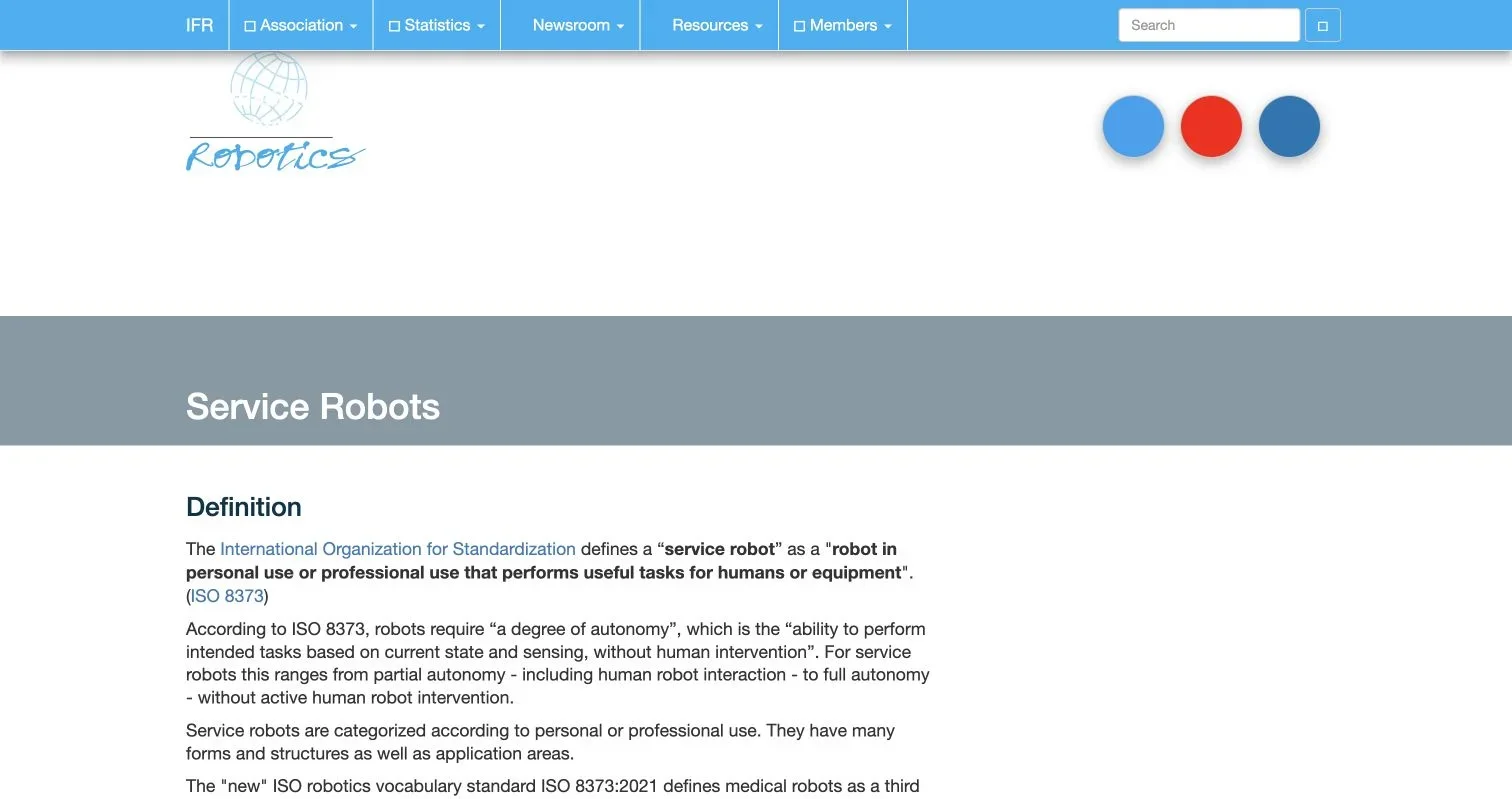
Source page reviewed in Chrome during article research. Follow the image link for the current page.
Service robot comparison: four robot form factors
A practical service robot comparison must look beyond polished demonstrations to production shifts, fault recovery, and service-level agreements.
| Factor | Humanoid | Wheeled mobile robot | Quadruped | Fixed robotic arm |
|---|---|---|---|---|
| Best terrain | Human spaces, stairs, mixed layouts | Smooth, mapped floors | Stairs, slopes, rubble, outdoor sites | One controlled workcell |
| Manipulation | Potentially broad, using one or two arms | None to moderate with an added arm | Usually limited; arm is optional | Excellent inside its designed reach |
| Stability | Lowest; balancing is continuous | High on suitable floors | High on irregular terrain | Very high |
| Energy efficiency | Low | Highest for mobile work | Moderate to low | High for repetitive work |
| Payload efficiency | Usually modest relative to total mass | Good | Modest | Excellent |
| Safety challenge | Whole-body motion and fall risk | Traffic, crushing, and payload movement | Trips, contact, and changing gait | Pinch, impact, and workcell hazards |
| Typical cost pattern | High purchase price or pilot/RaaS contract | Broad range; mature commercial market | High acquisition plus sensor payloads | Mature hardware, with integration often exceeding arm cost |
| Maintenance burden | Many joints, actuators, hands, and balance systems | Wheels, batteries, sensors, and drive modules | Leg actuators, joints, feet, and sealed components | Predictable wear in joints, cables, tooling, and safety equipment |
| Commercial maturity | Early deployments and controlled pilots | Widely deployed | Commercially available for inspection | Deep production history |
The best robot form factor is the simplest machine that meets the required cycle time, availability, safety case, and operating cost.
Where each robot form factor earns its keep
Humanoids: compatibility with human infrastructure
Factories, hospitals, stores, and homes were built around human reach, door widths, stairs, shelves, tools, and workstations. A capable biped could use them without a large facilities project.
Good candidate tasks include:
- Moving totes between stations designed for standing workers
- Loading machines where controls and doors sit at human height
- Handling mixed objects in brownfield facilities
- Performing low-volume tasks that change too often for dedicated automation
- Working in areas where stairs rule out wheeled platforms
Walking consumes energy, hands remain difficult to make strong, and a tall machine can fall. Many demonstrations still depend on constrained tasks, staged objects, remote supervision, or prepared surroundings.
Commercial activity is moving beyond pure research, including logistics trials involving Agility Robotics’ Digit. Yet operating in a real facility differs from consistently meeting production targets. One deployment proves feasibility, not universal labor economics.
Typical software combines:
- Learned locomotion policies, often trained with reinforcement learning
- Computer vision and force sensing
- Motion planning and whole-body control
- Vision-language-action models for interpreting instructions or selecting actions
- Teleoperation or human intervention for recovery and data collection
Treat the VLA label skeptically. A language-capable policy may interpret “put the blue container on the lower shelf,” but still needs collision checking, force limits, deterministic safety controls, and recovery procedures.
Wheeled robots: the practical service robot choice
Warehouses, hospitals, hotels, and homes use effective wheeled machines for material movement, delivery, cleaning, security, and domestic floor care.
Common examples include:
- Autonomous mobile robots carrying racks, carts, or bins
- Hospital delivery robots moving meals, linens, or supplies
- Commercial floor scrubbers and domestic robot vacuums
- Telepresence and security patrol platforms
- Mobile manipulators operating on smooth factory floors
Most rely on classical robotics: lidar or visual SLAM, map localization, route planning, obstacle detection, fleet scheduling, and rule-based recovery. Machine learning may improve perception, but the dependable core is often conservative.
Wheeled robots struggle with:
- Stairs and large thresholds
- Loose soil, rubble, cables, and deep drainage channels
- Reaching objects unless an arm or lift is added
- Crowded areas where people unpredictably block routes
For transport on prepared floors, dozens of articulated joints are an expensive substitute for four wheels.
Quadruped robots: mobility for inspection, not a metal pack animal
Quadrupeds balance wheeled efficiency with humanoid adaptability. Commercial platforms can traverse stairs, grating, construction sites, mines, utility facilities, and industrial plants while carrying cameras or sensing payloads.
They excel at:
- Thermal, acoustic, and visual inspection
- Gas detection and environmental monitoring
- Remote assessment after an incident
- Mapping construction or mining sites
- Repeated rounds in spaces unsafe or tiring for people
Production value usually comes from the sensors and inspection workflow, not walking. A quadruped that records thousands of images without turning them into maintenance actions is an expensive camera tripod with knees.
Modern quadrupeds mix learned locomotion or terrain policies with conventional state estimation, mapping, path planning, and safety constraints. Some carry an arm, but manipulation reduces runtime and complicates integration. For carrying heavy material over smooth concrete, a wheeled cart remains saner.
Fixed robot arms: the production benchmark
A fixed industrial or collaborative arm trades mobility for speed, stiffness, payload, repeatability, and predictable safety boundaries, advantages proven across decades of welding, painting, machine tending, assembly, packaging, and palletizing.
Fixed arms are usually the right answer when:
- Parts arrive at a known location
- The motion repeats frequently
- Cycle time matters
- Fixtures or conveyors can control variation
- The task stays within a defined work envelope
AI is optional. Traditional programming, machine vision, force control, and programmable logic controllers still run extensive automation. Learned perception can help with random bin picking or variable products, but “AI-powered” does not prove better uptime.
The arm is only one budget item. Tooling, guarding, conveyors, fixtures, vision, programming, validation, and line downtime can cost as much as or more than the manipulator.
Safety, energy, and maintainability change the answer
A strong demo shows task completion; plant managers and hospital administrators must assess the other 99 percent of the operating year.
| Item | What to check | Why it matters |
|---|---|---|
| Failure mode | What happens after a sensor, network, battery, or actuator fault? | A graceful stop is safer and cheaper than a fall or dropped load |
| Human contact | Can people enter the operating area, and at what robot speed? | Shared spaces require a different risk assessment from fenced cells |
| Runtime | Productive hours after charging, docking, and idle time | Advertised battery duration rarely equals useful shift coverage |
| Recovery | Who clears jams, remaps routes, or resets grasp failures? | Frequent intervention can erase labor savings |
| Wear components | Wheels, feet, hands, gearboxes, cables, seals, and batteries | More articulated joints generally mean more service points |
| Parts support | Stock location, technician response, and replacement lead time | A novel robot waiting weeks for an actuator produces nothing |
| Software lifecycle | Update policy, cybersecurity support, and API stability | A robot is also a networked computer with moving hardware |
| Evidence | Production hours, intervention rate, and completed cycles | A staged demonstration reveals little about availability |
The energy ranking is intuitive:
- A fixed arm uses energy only to move within its workcell.
- A wheeled platform rolls efficiently across suitable floors.
- A quadruped repeatedly supports and repositions its body.
- A humanoid must balance, walk, manipulate, and often power a large perception stack.
Payload, speed, and terrain can change the order, but branding cannot change physics. Each joint adds mass, control complexity, heat, wiring, and a failure point.
Safety standards also depend on application. The IFR overview points readers to standards including ISO 13482 for personal-care robots and ISO 3691-4:2023 for driverless industrial trucks and their systems. Procurement teams should involve a qualified integrator or safety professional; low-speed demo mode does not make a system safe.
Cost: ask for the operational number
Robot prices are hard to compare because vendors mix hardware sales, leases, Robotics as a Service (RaaS) subscriptions, usage charges, pilot fees, and custom integration. Humanoid pricing is especially opaque because many programs remain limited, announced, or contract-based.
Request a three- to five-year total-cost model covering:
- Robot, charger, docking equipment, and required sensor payloads
- End effectors, fixtures, carts, elevators, doors, or facility changes
- Mapping, programming, systems integration, and safety validation
- Fleet software, cloud services, connectivity, and API access
- Preventive maintenance, spare parts, and battery replacement
- On-site support and guaranteed response times
- Human supervision, exception handling, and remote assistance
- Expected residual value or end-of-contract removal
Calculate cost per successful pallet moved, room cleaned, inspection completed, machine cycle served, or item picked. Cost per robot-hour can hide paid time spent charging or awaiting help.
Including integration, a mature fixed arm or AMR may look expensive, but its output and maintenance are easier to estimate. A humanoid pilot is less certain; budget to learn what fails, not just to rent hardware.
Diagram-ready decision flow
Use this flow before vendor demonstrations. It favors simpler machines because complexity must earn its place.
flowchart TD
    A[Define the measurable job] --> B{Must the robot travel?}
    B -- No --> C{Is the task inside one repeatable workcell?}
    C -- Yes --> D[Choose a fixed arm]
    C -- No --> E[Redesign the process or use human-assisted tooling]
    B -- Yes --> F{Are floors smooth and routes accessible?}
    F -- Yes --> G{Does the robot need manipulation?}
    G -- No --> H[Choose a wheeled AMR or task-specific service robot]
    G -- Yes --> I{Can a mobile arm reach all targets?}
    I -- Yes --> J[Choose a wheeled mobile manipulator]
    I -- No --> K{Are stairs or human-only workstations unavoidable?}
    K -- Yes --> L[Evaluate a humanoid pilot]
    K -- No --> M[Modify the site or use fixed automation]
    F -- No --> N{Is the primary job inspection or sensing?}
    N -- Yes --> O[Choose a quadruped]
    N -- No --> P{Is human-like manipulation essential?}
    P -- Yes --> L
    P -- No --> Q[Use a specialized tracked, wheeled, or agricultural platform]
    D --> R[Validate safety, uptime, recovery, and total cost]
    H --> R
    J --> R
    L --> R
    O --> R
    Q --> R
The flow filters options but does not replace a site study. Hospitals may have elevators but strict infection-control requirements. Farms may need large tires or tracks rather than legs. Homes add children, pets, clutter, rugs, reflective surfaces, and owners unwilling to tolerate daily reboots.
How to run a credible pilot
A pilot should test the job’s ugly parts. Perfect lighting, fresh batteries, nearby vendor engineers, and positioned objects produce reassuring videos, not useful evidence.
-
Write the acceptance test first. Specify the task volume, cycle time, payload, operating hours, permitted intervention rate, and minimum availability.
-
Use the real environment. Include normal floor transitions, clutter, noise, lighting changes, people, network dead zones, and representative objects.
-
Record every intervention. Separate safety stops, perception failures, navigation faults, bad grasps, depleted batteries, and operator errors.
-
Test recovery. Disconnect the network, obstruct a route, move an object, introduce a reflective surface, and simulate a failed tool pickup within agreed safety limits.
-
Measure downstream work. A robot may move a tote successfully while leaving it misaligned for the next station. Completion must mean the process continued correctly.
-
Remove vendor hand-holding. Run part of the trial with only the staff and support arrangement expected after purchase.
-
Price the production version. Include redundant units, chargers, spares, integration, service coverage, and internal labor.
A useful pilot report should cover:
- Successful tasks per operating hour
- Human interventions per 100 tasks
- Mean time to recover and mean time between failures
- Fully loaded cost per successful task
The honest verdict
Humanoids have the broadest theoretical role and weakest default business case. They excel when a site cannot be economically redesigned and work demands mobility, human-like reach, and manipulation. That combination exists, especially in old facilities, but is rarer than marketing suggests.
Wheeled robots are the practical choice for most indoor transport and cleaning. Quadrupeds justify themselves on terrain and inspection access. Fixed arms remain standard for repeatable manipulation because controlled environments beat heroic generality.
The winning robot may look unimpressive. Good production robotics attracts no audience.
Before signing, require the vendor to classify the system:
- Commercially deployed: customers use it in routine operations with support and measurable output.
- Limited commercial or pilot: selected customers are testing it under constrained terms.
- Announced: specifications, price, or delivery schedule may still change.
- Research demonstration: the system proves a capability, not a production service.
That classification, decision flow, and operating data reveal more than whether the robot has a face.
Frequently Asked Questions
How do I choose the right robot form factor for my operation?
Start with the measurable task, environment, payload, cycle time, and required availability. Choose the simplest design that can meet those requirements safely: typically a fixed arm for repeatable workstation tasks, wheels for prepared floors, a quadruped for difficult terrain, or a humanoid when human-oriented infrastructure and varied manipulation are unavoidable.
When does a humanoid robot make practical business sense?
A humanoid may be appropriate when a robot must use stairs, doors, tools, shelves, and workstations designed for people, and modifying the site would be prohibitively expensive. Because humanoids generally have higher costs, lower energy efficiency, and more complex maintenance, buyers should validate the case through a tightly scoped pilot.
What costs should be included beyond the robot’s purchase price?
Include integration, tooling, chargers, safety equipment, facility changes, software subscriptions, connectivity, maintenance, spare parts, batteries, and staff time for supervision and recovery. Compare options using the fully loaded cost per successfully completed task over three to five years, rather than the advertised price or hourly rate.
Which performance metrics should a robot pilot track?
Track successful tasks per operating hour, interventions per 100 tasks, productive runtime, availability, mean time between failures, and mean time to recover. A task should count as successful only when the downstream process can continue without corrective work.
How should we test robot reliability before deployment?
Run the pilot in the real operating environment with normal traffic, clutter, lighting changes, floor transitions, network gaps, and representative objects. Safely test route blockages, sensor or network faults, low batteries, failed grasps, and recovery procedures without relying continuously on vendor engineers.
Does an AI-powered robot provide better performance than traditional automation?
Not automatically. Learned models can improve perception, instruction interpretation, and adaptation, but reliable operation still depends on motion planning, safety controls, force limits, fault handling, and stable integration with existing systems.
What vendor evidence should we request before signing a contract?
Ask for production hours, completed cycles, intervention rates, uptime, support response times, parts availability, and results from comparable customer environments. Also confirm whether the system is routinely deployed, available only through limited pilots, merely announced, or still a research demonstration.