Best Humanoid Robots for Home Use in 2026
Table of Contents
- TL;DR: humanoid robots for home use in 2026 offer hardware, not Rosie
- Home humanoid robot availability: shipping, preorder, or concept?
- What today’s home humanoid robots actually do
- 1X NEO: the clearest home-first proposition
- Weave Isaac 1: less humanoid, potentially more practical
- Unitree G1: a home humanoid robot platform, not a maid
- Unitree R1: inexpensive access to a humanoid body
- Fauna Sprout: a friendly developer platform
- AI home robot autonomy: what “AI-powered” means in practice
- Safety, privacy, and support matter more than dancing
- The real cost of ownership
- Home-readiness checklist
- How to evaluate and buy a humanoid robot
- Who should buy a humanoid robot in 2026?
- The buying reality
- TL;DR: humanoid robots for home use in 2026 offer hardware, not Rosie
- Home humanoid robot availability: shipping, preorder, or concept?
- What today’s home humanoid robots actually do
- 1X NEO: the clearest home-first proposition
- Weave Isaac 1: less humanoid, potentially more practical
- Unitree G1: a home humanoid robot platform, not a maid
- Unitree R1: inexpensive access to a humanoid body
- Fauna Sprout: a friendly developer platform
- AI home robot autonomy: what “AI-powered” means in practice
- Safety, privacy, and support matter more than dancing
- The real cost of ownership
- Home-readiness checklist
- How to evaluate and buy a humanoid robot
- Who should buy a humanoid robot in 2026?
- The buying reality
TL;DR: humanoid robots for home use in 2026 offer hardware, not Rosie
The market for humanoid robots for home use in 2026 is real, but buying one is awkward. Some companies sell walking robots or developer platforms; others accept refundable deposits for future household assistants. None offers a mature, broadly deployed appliance that can independently run an ordinary home.
That distinction matters. A robot performing laundry in a controlled video may rely on:
- A carefully arranged room and known objects
- A task-specific learned policy
- Remote human supervision when autonomy fails
- Multiple attempts edited into one smooth demonstration
- Engineers who are absent from the final shot
You can buy credible products for experimenting with locomotion, perception, or robot learning. If you expect one to cook, clean, and safely supervise children, keep your wallet closed.
Status in this guide was checked on July 18, 2026. Availability can differ by country, configuration, and distributor.
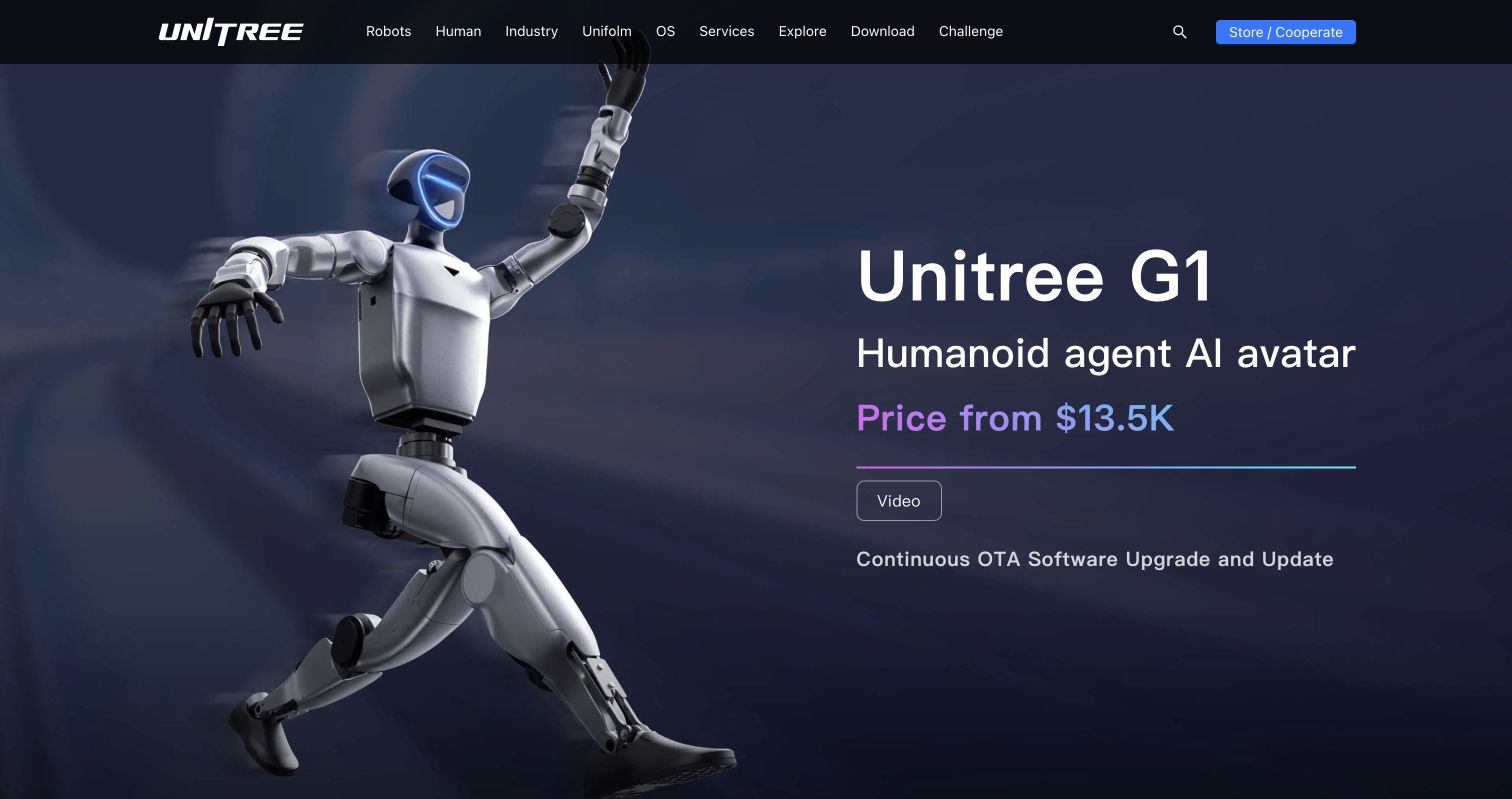
Screenshot: Unitree G1 product page, captured July 2026. Verify current pricing, configuration, and availability with the manufacturer.
Home humanoid robot availability: shipping, preorder, or concept?
For humanoid robots, “available” can mean anything from warehouse inventory to a sales-contact form.
| Robot | Purchase status | Published price | What the status really means | Home readiness |
|---|---|---|---|---|
| Unitree G1 | Orderable platform | From $13,500 | Commercial hardware; tax and shipping excluded. The base edition lacks secondary-development support | Low |
| Fauna Sprout | Shipping via request process | Quote required; about $50,000 reported | Developer and research platform with SDK access, not a finished domestic appliance | Low to moderate |
| Unitree R1 | Priced product; confirm regional fulfillment | From $4,900 | Entry-level mobility platform. Base versions lack dexterous hands and secondary development | Very low |
| 1X NEO | Preorder/reservation | $20,000 or $499/month; $200 refundable deposit | U.S. deliveries are stated to start in 2026. A reservation is not shipping inventory | Moderate, if promised delivery and support materialize |
| Weave Isaac 1 | Preorder | $7,999 or $449/month; $250 refundable deposit | Initial California deliveries planned for fall 2026, followed by broader U.S. availability in 2027 | Moderate for defined chores |
| Figure 03 | Partner deployments/announced home ambitions | No public retail price | No normal consumer checkout or confirmed retail inventory | Not purchasable |
| Tesla Optimus | Development program | No official retail price | Tesla describes the technical goal, but offers no official consumer order page | Not purchasable |
The market is also covered in this Forbes overview of humanoids that buyers can access. The rule is simple: a deposit buys a place in line, not a robot in your house.
What today’s home humanoid robots actually do
1X NEO: the clearest home-first proposition
1X NEO is the closest match to the popular idea of a home humanoid robot. This 5-foot-6-inch, 66-pound biped has a soft exterior, articulated hands, voice interaction, an app, automatic charging, four hours of runtime, and a 55-pound carrying capacity.
NEO is intended to handle chores such as:
- Fetching or moving household objects
- Opening doors
- Tidying rooms
- Assisting with laundry
- Responding to voice commands
- Running scheduled routines
Its Redwood AI model combines vision and language for learning household tasks. A built-in language model handles conversation, while the mobile app controls schedules, monitoring, and remote operation.
The catch: 1X explicitly describes Scheduled Expert Mode. When NEO encounters a task it cannot complete, a remote expert can supervise its actions at an agreed time. That may improve autonomy, but it means another person may see inside your home through its cameras.
The $200 deposit is refundable, and 1X says U.S. deliveries start in 2026. Until customers report sustained use of production units, treat NEO as an early-access preorder, not a proven appliance.
Weave Isaac 1: less humanoid, potentially more practical
Isaac 1 has a wheeled base, telescoping body, arms, and simple grippers. Purists may reject the humanoid label because it does not walk. At home, wheels are stable, effective, and less likely to turn a rug edge into a dramatic robotics incident.
Weave defines two initial task areas:
- Laundry Flow: finding clothes, handling hampers, folding items, and putting them away
- Daily Reset: making beds, adjusting pillows, and returning toys, shoes, or clutter to their places
The company says these routines are autonomous by default, with teleoperation used when assistance is needed. Isaac 1 is listed with eight hours of battery life and app-based scheduling.
The preorder costs $250 and is refundable until shipment. Weave says first deliveries begin in California in fall 2026. Buyers elsewhere in the United States may wait until 2027. Planned shipments do not prove a large installed fleet.
Unitree G1: a home humanoid robot platform, not a maid
The Unitree G1 is genuine commercial robot hardware. The base model starts at $13,500, excluding taxes and shipping, and provides bipedal locomotion, a depth camera, 3D LiDAR, microphones, a speaker, and about two hours of battery life.
Buyers often miss the configuration gap:
- The standard G1 has 23 degrees of freedom and no dexterous hands
- The base model does not support secondary development
- G1 EDU configurations can add development access, compute, wrists, and dexterous hands
- EDU pricing requires a sales conversation
- Unitree lists an eight-month warranty for the base model
Imitation learning and reinforcement learning appear prominently in Unitree’s positioning. Those methods can produce excellent movement, but agility is not household competence. A robot that can recover its balance or perform a practiced motion does not automatically know how to identify delicate glassware, sort laundry, or clean an unfamiliar kitchen.
I like the G1 for research and engineering, but would not expect useful domestic labor from the base version.
Unitree R1: inexpensive access to a humanoid body
The Unitree R1 starts at $4,900 for the R1 AIR and $5,900 for the R1, before tax and shipping. It stands no more than 123 centimeters tall, weighs roughly 27 to 29 kilograms, and runs for about one hour.
Its strengths are:
- Agile bipedal movement
- Voice and image functions using a multimodal model
- Accessible joint and sensor interfaces on appropriate configurations
- A relatively low entry price for humanoid hardware
Its limitations matter more to home buyers. The AIR and standard R1 do not include dexterous hands or secondary-development support. Only the quote-based EDU configuration offers them. Without functional hands, the cheapest R1 cannot fold towels, unload dishes, or reliably handle household objects.
Enthusiasts may enjoy this platform, but it is neither a low-cost AI home robot nor a NEO substitute.
Fauna Sprout: a friendly developer platform
Fauna Robotics says Sprout is shipping today through a request process. The compact robot has a soft exterior, compliant control, whole-body teleoperation, grippers, and full SDK access. It targets research groups, developers, schools, and companies building interactive experiences.
Sprout can support work involving:
- Human-robot interaction
- Locomotion and manipulation research
- Data collection for learned policies
- Entertainment or character applications
- Reception and guided social exchanges
Fauna discusses future assistant and companion applications, but buyers get a platform for building them, not a complete AI home robot with reliable chores.
AI home robot autonomy: what “AI-powered” means in practice
Home robots combine several technologies that marketing groups under “AI,” despite their different roles.
| Approach | What it does | Where it helps | What it does not guarantee |
|---|---|---|---|
| Classical mapping and navigation | Builds a map, estimates position, and plans motion | Moving between known rooms and avoiding obstacles | Safe manipulation or task understanding |
| Reinforcement learning policies | Learns actions through rewards in simulation or real environments | Balance, walking, recovery, and practiced motions | Reliable performance on unseen household tasks |
| Imitation learning | Learns from human demonstrations or teleoperation data | Folding, grasping, and repeatable manipulation | General reasoning outside the training distribution |
| Vision-language-action models | Connects visual observations and language instructions to robot actions | More flexible object and task interpretation | Error-free physical execution |
| Teleoperation | Lets a person directly or indirectly control the robot | Recovering failed tasks and gathering training data | Autonomous service |
Current products mix these approaches. A robot may navigate autonomously, use a learned policy to grasp a shirt, and call an operator when it falls behind a chair.
That legitimate hybrid model may advance home robotics. Still, buyers should know when “the AI did the laundry” means a remote operator rescued it.
Safety, privacy, and support matter more than dancing
Even a humanoid lighter than an adult can cause injury through powered joints, batteries, cameras, microphones, and changing software. Unitree itself tells individual buyers to maintain a sufficient safety distance and understand the industry’s limitations.
Before bringing one home, consider these risks:
- Falls: stairs, rugs, pets, cables, and wet floors can defeat locomotion systems
- Pinch and impact hazards: hands and joints may trap fingers or strike people during unexpected motion
- Tool hazards: knives, hot cookware, glass, chemicals, and powered appliances require far better reliability than picking up blocks
- Children and pets: unpredictable movement creates cases that demonstrations rarely cover
- Remote access: teleoperation may expose video, audio, room layouts, possessions, and daily routines
- Software dependence: cloud shutdowns or discontinued services can remove much of a robot’s usefulness
Ask whether video leaves the robot, how long recordings remain, whether data trains future models, and whether operators can connect without fresh approval. A glowing indicator is helpful, but it is not a privacy policy.
Support is another problem: appliance technicians cannot repair tendon-driven arms or recalibrate humanoid perception systems. Confirm:
- Who pays for freight when repairs are needed
- Whether technicians operate in your country
- How long replacement batteries and actuators will remain available
- What functionality remains if the company or cloud service closes
- Whether the warranty permits ordinary household use
The real cost of ownership
The advertised price excludes potential shipping, customs, taxes, accessories, and commissioning costs. Subscription robots create a different risk: years of payments without ownership.
| Cost category | Questions to ask |
|---|---|
| Robot or subscription | Is the price for the usable configuration or an entry model without hands and SDK access? |
| Freight and import | Are delivery, customs brokerage, duties, and return shipping included? |
| Accessories | Are batteries, charger, grippers, hands, compute modules, and controller included? |
| Software | Does useful autonomy require a subscription, paid API, or separate developer license? |
| Installation | Will the home need charging space, stronger Wi-Fi, gates, ramps, or furniture changes? |
| Maintenance | What are the expected battery, actuator, cable, and joint replacement intervals? |
| Supervision | Does teleoperation cost extra, and how much owner time is required? |
| Insurance | Will home or business insurance cover a mobile autonomous machine? |
At $499 per month, NEO costs $17,964 over three years before any extra fees. Isaac 1 at $449 per month reaches $16,164 over the same period. Subscription, cancellation, service, and return terms matter as much as the monthly price.
Home-readiness checklist
| Item | What to Check | Why It Matters |
|---|---|---|
| Purchase status | Confirm whether the unit is in stock, allocated, or merely reserved | A preorder date can move without producing a deliverable robot |
| Task evidence | Request an unedited demonstration in a home similar to yours | Controlled videos hide retries and environmental constraints |
| Autonomy | Ask which tasks need teleoperation and how often | Human rescue changes privacy, cost, and service expectations |
| Configuration | Verify hands, compute, SDK, battery, charger, and controller | Entry prices may exclude the equipment needed for useful work |
| Floor plan | Check stairs, thresholds, rugs, narrow passages, and charging space | Many homes are harder to move through than robotics labs |
| Safety controls | Locate physical stop controls and learn fall-recovery procedures | App-only control may be inadequate during a fault |
| Children and pets | Obtain written guidance for occupied-home operation | Unpredictable contact raises injury and damage risks |
| Privacy | Review recording, retention, training, and remote-access policies | The robot’s sensors observe unusually sensitive spaces |
| Connectivity | Determine what works offline and what requires cloud access | An internet or vendor outage may disable core functions |
| Warranty and repair | Confirm coverage, exclusions, parts supply, and freight responsibility | Robot repairs can be slow and expensive |
| Return terms | Read deposit, cancellation, restocking, and return-shipping clauses | Refundable does not always mean frictionless |
How to evaluate and buy a humanoid robot
-
Write down one job you need completed. “Help around the house” cannot be tested. “Collect clothing from two bedrooms and fold T-shirts” can.
-
Ask for a continuous demonstration. It should use representative lighting, furniture, objects, flooring, and obstacles. Find out whether the robot was autonomous throughout.
-
Get the exact configuration in writing. Model names often cover very different hands, processors, software permissions, and warranties.
-
Separate failure recovery from the main task. Ask what happens after a dropped object, network interruption, fall, blocked route, or changed room layout.
-
Calculate a three-year cost. Include subscriptions, shipping, tax, maintenance, accessories, teleoperation, and the time required to supervise it.
-
Read the privacy and support terms before the preorder agreement. A refundable deposit is easy to understand. Permanent cameras and uncertain service coverage require more thought.
Who should buy a humanoid robot in 2026?
A purchase may suit:
- Robotics labs needing physical platforms for learning and control research
- System integrators building demonstrations or custom applications
- Universities teaching locomotion, perception, and human-robot interaction
- Companies with engineering staff and a tightly defined pilot
- Enthusiasts who understand they are buying an experimental machine
- Early adopters comfortable with teleoperation and changing capabilities
Most households should wait. A single-purpose robot vacuum, mower, or pool cleaner will usually work more reliably at a fraction of the cost. Boring competence wins in the home.
If you still want to buy a humanoid robot, match the purchase to the real objective:
- Choose Unitree or Sprout when the objective is development and research
- Consider NEO when the objective is early access to a bipedal household-assistance service
- Consider Isaac 1 when defined chores matter more than having legs
- Treat Figure and Optimus as products to monitor, not items in a 2026 purchasing budget
The buying reality
The AI home robot market in 2026 is “commercially accessible, operationally experimental.” Buyers can obtain sophisticated humanoid bodies or reserve machines designed for household chores. What they cannot yet buy is effortless general-purpose domestic autonomy.
That is healthier than treating a polished video as a product category. Hardware is improving quickly, learning systems are becoming more general, and remote assistance helps early robots complete useful work. Still, homes are chaotic and safety-sensitive, and progress must survive outside the demo room.
Buy for experimentation now. Buy for dependable chores only after the delivery record, support network, and real-world autonomy catch up with the promise.
Frequently Asked Questions
Can I buy a humanoid robot for my home in 2026?
Yes, with caveats. Unitree sells humanoid hardware, and Fauna offers a shipping developer platform through a request process. Home-first products such as NEO and Isaac 1 are taking refundable deposits for planned deliveries. None has the maturity or deployment record of an established consumer appliance.
What is the best home humanoid robot to buy now?
There is no clear winner. NEO has the clearest bipedal home design but remains an early-access preorder. Isaac 1 targets practical chores and has a lower price, but it uses wheels. Unitree’s robots are better understood as mobility or development platforms.
Is the Unitree G1 suitable for household chores?
Not as a finished appliance. The base G1 lacks dexterous hands and secondary-development support. A suitably configured EDU model can support manipulation research, but owners must develop, integrate, and supervise the application.
Is 1X NEO fully autonomous?
No. 1X says early units arrive with basic autonomy and improve over time. The company also offers scheduled remote expert supervision for complex or unfamiliar tasks.
Can I order Tesla Optimus or Figure 03?
Not through an official consumer sales channel as of July 18, 2026. Tesla’s official page describes Optimus as a development goal and recruitment program, while Figure has focused on demonstrations and partner deployments. Be suspicious of unofficial sites accepting deposits.
Are home robots safe around children and pets?
Do not assume so. Ask the manufacturer for written operating limits covering children, pets, stairs, tools, and unsupervised use. Soft coverings and compliant actuators reduce some hazards but do not eliminate falls, collisions, or software errors.
Do AI home robots record inside the house?
They generally use cameras, microphones, and mapping sensors. Vendor policies determine whether data is stored, uploaded, reviewed, or reused for training. Review those policies before ordering, especially when teleoperation is part of the product.
Should I preorder or wait?
Preorder only if the deposit is comfortably disposable, the refund terms are clear, and you accept schedule and capability changes. Anyone seeking dependable household labor should wait for owner reports.
How can I verify that a robot can perform the household task I need?
Ask for a continuous, unedited demonstration in a home with flooring, furniture, lighting, and obstacles similar to yours. Confirm which parts were autonomous, how many failures occurred, and whether a remote operator intervened.
What should I confirm before paying a preorder deposit?
Review the refund deadline, cancellation process, expected delivery region, and whether the date is guaranteed or only estimated. Get the exact hardware configuration, included accessories, warranty coverage, and subscription requirements in writing.
What costs should I expect beyond the advertised price?
Budget for taxes, freight, customs duties, accessories, software, maintenance, replacement batteries, and possible teleoperation fees. Return shipping for repairs can also be significant, especially when the manufacturer has no local service network.
What happens when a home robot cannot complete a task?
Depending on the product, it may stop, request assistance, retry, or connect to a remote operator. Ask how often intervention is expected, whether it costs extra, and what video or audio the operator can access.
Will a humanoid robot work in a home with stairs, rugs, or narrow spaces?
Not necessarily, because thresholds, loose rugs, cables, stairs, and tight passages can disrupt navigation or balance. Have the vendor assess your floor plan and provide written operating limits before ordering.
What features may be missing from an entry-level robot?
Low advertised prices may exclude dexterous hands, development access, sufficient computing hardware, controllers, or useful software capabilities. Compare the quoted configuration against the specific job you want the robot to perform.
What will still work if the internet connection or manufacturer’s cloud service fails?
Offline capability varies widely, and some robots may lose voice control, remote assistance, scheduling, or learned behaviors without cloud access. Ask the manufacturer to identify which essential functions run locally and whether the robot remains operable if its services are discontinued.