Humanoid Robot Price 2026: Costs and Buyer Guide
Table of Contents
- TL;DR: Humanoid robot price 2026
- Published humanoid robot price data for 2026
- The $13,500 Unitree G1 AI humanoid robot price, examined properly
- What changes the final humanoid robot cost
- Home robot cost: purchase versus subscription
- Industrial humanoids are sold as outcomes, not boxes
- How the AI affects price and usefulness
- A realistic three-year robot total cost of ownership example
- Buyer checklist before accepting a humanoid robot price
- Is the humanoid robot cost worth it in 2026?
- TL;DR: Humanoid robot price 2026
- Published humanoid robot price data for 2026
- The $13,500 Unitree G1 AI humanoid robot price, examined properly
- What changes the final humanoid robot cost
- Home robot cost: purchase versus subscription
- Industrial humanoids are sold as outcomes, not boxes
- How the AI affects price and usefulness
- A realistic three-year robot total cost of ownership example
- Buyer checklist before accepting a humanoid robot price
- Is the humanoid robot cost worth it in 2026?
TL;DR: Humanoid robot price 2026
The humanoid robot price in 2026 ranges from $4,290 to more than $100,000, with important caveats. The least expensive machines are limited platforms, while commercially supported industrial deployments are usually priced by quotation or through Robots-as-a-Service agreements.
For buyers comparing costs:
- Entry-level hardware: $4,290 to $20,000, before tax, integration, or development equipment
- Research and developer platforms: roughly $25,000 to $100,000+, depending on hands, computing, sensors, and support
- Industrial deployments: price unavailable publicly; typically negotiated as a pilot, purchase, or RaaS contract
- Three-year home subscription: about $17,964 at $499 per month, assuming the price does not change
- Practical first-year budget: often 20% to 100% above the advertised hardware price
A robot in a polished video appears self-contained. A working deployment needs batteries, charging, software, safety work, training, integration, maintenance, and someone to rescue the machine when reality refuses to follow the demo script.
| Price label | Meaning | Confidence |
|---|---|---|
| Quoted | Published by the manufacturer on a current official page | High, but configuration and regional terms may change |
| Estimated | Planning allowance based on the stated assumptions | Useful for budgeting, not a vendor quote |
| Unavailable | Manufacturer does not publish a current selling price | Buyer must contact sales |
Source page reviewed in Chrome during article research. Follow the image link for the current page.
Published humanoid robot price data for 2026
The table separates orderable products from sales-led industrial programs; announced robots are not necessarily stocked.
| Robot | Published price | Availability in 2026 | What the price actually buys |
|---|---|---|---|
| Unitree R1-D | From $4,290, quoted | Listed in Unitree’s online store | Compact customizable platform; final configuration can cost more |
| Unitree R1 | From $4,900, quoted | Listed in Unitree’s online store | Entry humanoid hardware rather than a finished household worker |
| Unitree G1 | $13,500, quoted | Orderable but shown as backordered when checked | Base model without secondary development support |
| 1X NEO Standard | $499/month, quoted | Subscription offering; delivery timing differs from Early Access | Home robot, software, and service package rather than ownership |
| 1X NEO Early Access | $20,000, quoted | Priority US deliveries announced for 2026 | Ownership, three-year warranty, and premium support |
| Unitree H2 | $29,900, quoted | Store listing directs buyers to contact sales | Full-size humanoid; configuration and delivery terms require confirmation |
| Unitree H1 | $90,000 store listing | Contact required for the real price | Industrial/research-class hardware; displayed figure is not a final quotation |
| Unitree H2 Plus | $100,000, quoted listing | Sales-led purchase | Research-oriented humanoid platform |
| Agility Digit | Unavailable | Commercial RaaS deployments at GXO and Toyota | Robot, Agility Arc fleet software, deployment, and service terms |
| Apptronik Apollo 2 | Unavailable | Training fleets and customer/partner deployments | Modular wheeled or bipedal industrial platform |
| Figure 03 | Unavailable | Manufacturer program, not a public retail checkout product | Humanoid designed around Figure’s Helix vision-language-action system |
| Tesla Optimus | Unavailable | Production preparations; no general retail sale | No verified public purchase price in 2026 |
Unitree prices come from its official online store and product pages. Unlike most humanoid vendors, the store displays prices, though these do not guarantee immediate stock or a production-ready application.
The $13,500 Unitree G1 AI humanoid robot price, examined properly
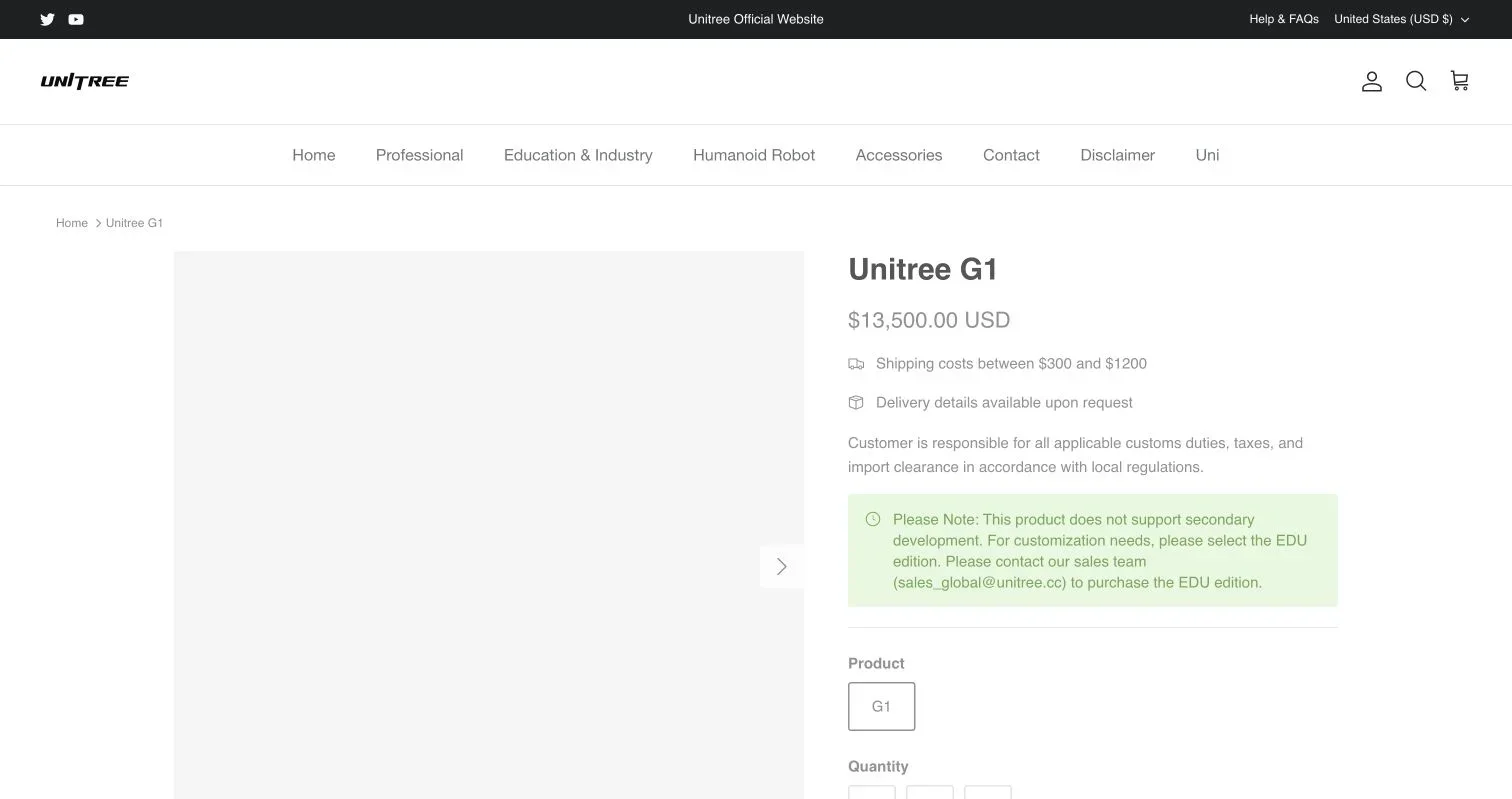
The current Unitree G1 store page quotes $13,500, plus shipping of $300 to $1,200. It says the customer is responsible for customs duties, taxes, and import clearance.
Source screenshot captured from Unitree’s official store in July 2026. Prices and availability can change.
More consequentially, the base product does not support secondary development. Buyers who need customization are directed to the G1 EDU edition, whose price is unavailable and must be requested from sales.
The official G1 specifications explain the distinction:
- Base G1: 23 degrees of freedom, no high-compute module, no secondary development, eight-month warranty
- G1 EDU: 23 to 43 degrees of freedom, NVIDIA Jetson Orin, secondary development support, 18-month warranty
- Battery: approximately two hours under the manufacturer’s stated conditions
- Learning approach: imitation learning and reinforcement learning, alongside Unitree’s UnifoLM work
$13,500 is the real price for that base machine, but not for custom manipulation policies, dexterous hands, production workflows, or longer support. Treat this price as a hardware entry point, not a complete project budget.
What changes the final humanoid robot cost
Hardware is only the first ownership cost. Buyers should request these categories explicitly.
| Cost component | Public price status | Planning allowance | What to verify |
|---|---|---|---|
| Robot hardware | Sometimes quoted | Published price or sales quote | Exact model, hands, sensors, compute, controller, and charger |
| Developer access | Often unavailable | $0 to $30,000+, estimated | SDK access, source access, simulation tools, API limits, and commercial-use rights |
| Software subscription | Sometimes quoted | $0 to $499+/month, estimated range | Autonomy features, cloud inference, fleet management, teleoperation, and updates |
| Integration | Rarely published | $10,000 to $150,000+, estimated | Workflow design, end effectors, PLC/WMS/MES links, mapping, and testing |
| Maintenance | Rarely published | 8% to 15% of hardware annually, estimated | Labor, travel, actuators, calibration, and response times |
| Spare batteries and charging | Often configuration-dependent | $1,000 to $10,000+, estimated | Battery quantity, certified chargers, storage, and replacement interval |
| Support and training | Usually quoted | $2,000 to $25,000+ annually, estimated | Remote support, on-site service, operator training, and software updates |
| Shipping | Sometimes quoted | Unitree G1: $300 to $1,200, quoted | Insurance, lift-gate service, crating, and return freight |
| Duties and tax | Buyer-specific | 0% to 30%+, estimated range | Tariff classification, VAT, sales tax, broker fees, and local rules |
| Safety and site work | Usually unavailable | $5,000 to $100,000+, estimated | Risk assessment, guarding, floor changes, networking, and compliance validation |
These estimates are broad because projects differ. Teaching one research robot to sort laboratory objects differs from connecting ten robots to a warehouse system operating around people and forklifts.
Home robot cost: purchase versus subscription
The clearest 2026 consumer comparison comes from 1X’s official NEO order page. Early Access ownership is $20,000, while the Standard plan is $499 per month. A refundable $200 deposit is due when ordering.
| NEO option | One year | Three years | Ownership at end | Important limitation |
|---|---|---|---|---|
| Standard subscription | $5,988, calculated | $17,964, calculated | No | Subscription deliveries are scheduled later than Early Access |
| Early Access purchase | $20,000, quoted | $20,000 before operating costs | Yes | Capability at delivery may be narrower than promotional demonstrations suggest |
The $2,036 three-year difference favors ownership, but the comparison is incomplete. A subscription may shift repair and upgrade risk to the supplier. Ownership includes a three-year warranty and premium support, but buyers must still ask about shipping, consumables, out-of-warranty service, and battery replacement.
NEO also shows that difficult home tasks can require scheduled remote expert supervision. Its Redwood AI model learns and repeats tasks, but humans may assist when it cannot work independently, making privacy, camera access, scheduling, and service availability purchasing factors.
Industrial humanoids are sold as outcomes, not boxes
Industrial vendors often withhold unit prices because robots are only part of a deployment. Agility’s Digit is a good example. GXO’s commercial agreement covers Digit robots and Agility Arc fleet software in a live warehouse, where the robots move totes between other mobile robots and conveyors.
That differs materially from a camera-ready prototype. Digit has also progressed from a GXO deployment to a 2026 RaaS agreement with Toyota Motor Manufacturing Canada. The contract price remains unavailable.
A plant evaluating Digit, Apollo, or Figure should expect the commercial discussion to include:
- Task throughput and acceptable failure rate
- Number of robots and charging strategy
- Fleet orchestration and software service levels
- Site integration and safety validation
- Remote assistance and incident response
- Minimum contract duration and early termination terms
- Data ownership, video retention, and model-training rights
A low RaaS fee is expensive if the robot completes too few useful cycles, while a six-figure robot can pay off by reliably covering a hazardous or chronically unfilled shift. Focus on cost per successful task.
How the AI affects price and usefulness
AI humanoid robot covers distinct technical stacks. Buyers should ask which layer performs each task.
| Approach | Where it fits | Cost implication | Practical concern |
|---|---|---|---|
| Classical control and navigation | Balance, joint control, mapped movement, repeatable routes | Usually embedded in hardware/software | Reliable within defined operating limits |
| Reinforcement-learning policy | Complex movements and behaviors trained in simulation or from reward signals | Training compute and engineering may be substantial | A spectacular movement policy does not equal general task competence |
| Imitation learning | Learning motions from demonstrations or teleoperation | Requires demonstration data and retraining | Performance depends on coverage of real conditions |
| Vision-language-action model | Converts visual and language inputs into actions; used by systems such as Figure Helix | May require cloud or high-end onboard compute | Latency, safety validation, and unpredictable edge cases matter |
| Teleoperation | Human directly controls or assists the robot | Adds recurring labor and connectivity costs | Autonomy claims may look better than the underlying economics |
Teleoperation and scripted automation can both deliver useful work. Problems arise when buyers pay for general autonomy but receive remote control and a narrow action library.
A realistic three-year robot total cost of ownership example
Consider a $13,500 Unitree G1 for demonstrations and non-programmable standard functions. This is estimated, not a Unitree quotation.
| Three-year cost | Low case | High case | Basis |
|---|---|---|---|
| Hardware | $13,500 | $13,500 | Quoted store price |
| Shipping | $300 | $1,200 | Quoted store range |
| Tax, duty, and brokerage | $0 | $4,050 | Estimated at 0% to 30% of hardware |
| Spares and battery allowance | $1,000 | $5,000 | Estimated |
| Maintenance after short warranty | $2,160 | $4,050 | Estimated at roughly 8% to 15% annually for two years |
| Training and support | $0 | $10,000 | Estimated; vendor agreement required |
| Basic site preparation | $1,000 | $5,000 | Estimated |
| Three-year total | $17,960 | $42,800 | Excludes custom development and downtime |
EDU research or industrial integration would cost more. Developer hardware, dexterous hands, engineering, safety work, and a custom application can push a $13,500 robot project beyond $100,000.
Buyer checklist before accepting a humanoid robot price
| Item | What to check | Why it matters |
|---|---|---|
| Commercial status | In stock, backordered, pilot-only, announced, or deployed | A press demonstration is not a delivery commitment |
| Scope of hardware | Hands, compute, sensors, batteries, charger, and controller | Needed components may be optional |
| Developer rights | SDK, APIs, documentation, simulation, and commercial license | Cheap hardware may prohibit secondary development |
| Autonomy boundary | Tasks completed without teleoperation or scripted reset | Determines labor savings and privacy exposure |
| Support terms | Warranty length, response time, parts location, and travel charges | Downtime can dominate ownership cost |
| Software fees | Cloud AI, fleet tools, updates, and per-task charges | Recurring fees alter the payback calculation |
| Import costs | Shipping, duty, VAT, brokerage, and return freight | Store prices commonly exclude them |
| Integration | PLC, MES, WMS, doors, elevators, networks, and cybersecurity | The robot must fit the existing operation |
| Safety | Risk assessment, certification evidence, exclusion zones, and emergency stops | A powerful moving machine cannot be evaluated like a laptop |
| Acceptance test | Throughput, uptime, intervention rate, and test duration | Converts a demo into a measurable purchase decision |
Is the humanoid robot cost worth it in 2026?
For enthusiasts and laboratories, the 2026 market offers real hardware below the price of many cars, though low-cost models may lack developer access, dexterous manipulation, or long warranties.
For households, 1X NEO has a concrete price and delivery plan but remains early in its product cycle. Expect capability limits, human assistance, and evolving software.
Factories and warehouses should start with the task, not the humanoid shape. Digit has evidence of paid work in real facilities. Apollo and Figure have industrial programs, but no public pricing. Tesla Optimus is not generally purchasable in 2026, regardless of future price predictions.
Calculate total ownership cost backward from the acceptance test. If the vendor cannot state the robot’s task, rate, and required human interventions, its advertised price reveals little. The cheapest machine completes useful work reliably; everything else is an expensive conversation piece.
Frequently Asked Questions
What is the cheapest humanoid robot available in 2026?
Entry-level models start at approximately $4,290, but these are limited platforms rather than complete household or industrial workers. The final cost can rise substantially once shipping, taxes, batteries, developer access, and support are included.
How much should I budget beyond the advertised robot price?
A practical first-year budget may be 20% to 100% higher than the hardware price. Integration, safety preparation, training, maintenance, import charges, software, and spare equipment are common additional expenses.
Can I program a low-cost humanoid robot for custom tasks?
Not necessarily, because some base models restrict secondary development or omit the required computing hardware and SDK access. Confirm developer rights, APIs, documentation, simulation tools, and commercial-use permissions before purchasing.
Is buying a home robot better than subscribing?
Buying can offer better long-term value and eventual ownership, while a subscription may reduce repair and upgrade risk. Compare the full contract terms, including warranty coverage, software updates, service availability, cancellation rules, and battery replacement.
Why do industrial humanoid robot vendors rarely publish prices?
Industrial systems are usually sold as deployments that combine robots, fleet software, integration, support, and performance commitments. Pricing therefore depends on the task, site conditions, robot quantity, service level, and contract duration.
How can I tell whether a robot is truly autonomous?
Ask which tasks it completes without teleoperation, scripted resets, or remote expert assistance. Measure intervention frequency, successful task cycles, latency, and failure recovery during a realistic acceptance test.
What is the best way to decide whether a humanoid robot is worth the cost?
Start with a defined task and calculate the cost per successful completion rather than comparing hardware prices alone. Include downtime, human supervision, integration, maintenance, recurring software fees, and the value of improved safety or coverage for hard-to-fill shifts.