Best AI Humanoid Robots in 2026: Prices & Uses
Table of Contents
- The short answer: best human robots with AI in 2026
- 1. Unitree G1: best AI humanoid robot most developers can order
- 2. Unitree R1: one of the lowest-cost humanoid robots for sale
- 3. Booster K1: best entry platform for education and robot soccer
- 4. EngineAI PM01: a purchasable platform for dynamic-motion research
- 5. LimX Oli: best full-size developer platform sold by consultation
- 6. 1X NEO: the clearest AI humanoid robot reservation for homes
- 7. Agility Digit: best commercially proven enterprise humanoid
- 8. UBTECH Walker S2: a commercial option for large industrial buyers
- Robots you still cannot simply buy
- What AI actually means in AI humanoid robots
- Buyer checklist before you buy a humanoid robot
- How to compare humanoid robot prices without buying the hype
- Final recommendation
- The short answer: best human robots with AI in 2026
- 1. Unitree G1: best AI humanoid robot most developers can order
- 2. Unitree R1: one of the lowest-cost humanoid robots for sale
- 3. Booster K1: best entry platform for education and robot soccer
- 4. EngineAI PM01: a purchasable platform for dynamic-motion research
- 5. LimX Oli: best full-size developer platform sold by consultation
- 6. 1X NEO: the clearest AI humanoid robot reservation for homes
- 7. Agility Digit: best commercially proven enterprise humanoid
- 8. UBTECH Walker S2: a commercial option for large industrial buyers
- Robots you still cannot simply buy
- What AI actually means in AI humanoid robots
- Buyer checklist before you buy a humanoid robot
- How to compare humanoid robot prices without buying the hype
- Final recommendation
The short answer: best human robots with AI in 2026
The best human robots with AI in 2026 are commercially real, but they serve several distinct markets. A university can order a capable biped for less than $6,000, a US household can deposit on a domestic robot, and a warehouse operator can contract for a fleet already moving totes in production. These are very different purchases.
Compare humanoid robots by availability and price, not acrobatics. A robot doing a backflip on video may still lack autonomous manipulation, workplace safety certification, spare-parts support, or a practical deployment package.
This shortlist uses official manufacturer information checked on July 19, 2026.
| Robot | Best fit | Market status | Public starting price | Where it is offered |
|---|---|---|---|---|
| Unitree G1 | Developers and research labs | Orderable hardware | $13,500 before tax and shipping | Official global store; confirm destination and import terms |
| Unitree R1 | Lower-cost biped research | Orderable hardware | $4,900 before tax and shipping | Official Unitree sales channel |
| Booster K1 | Education and RoboCup teams | Sales inquiry | $5,999 advertised | International inquiries; distributor support varies |
| EngineAI PM01 | Dynamic-motion and embodied-AI research | Listed for purchase | ¥188,000 | Chinese sales channel; verify export support |
| LimX Oli | Full-size research and integration | Buy/inquiry channel open | Quote required | Manufacturer-led enterprise and research sales |
| 1X NEO | Early adopters seeking a home robot | Refundable US preorder | $20,000 ownership or $499/month later | US deliveries start in 2026; other markets from 2027 |
| Agility Digit | Warehouses and factories | Commercial RaaS deployment | Quote required | Enterprise projects in selected markets |
| UBTECH Walker S2 | Large industrial programs | Mass production and enterprise delivery | Quote required | Primarily manufacturer-led industrial projects |
Unitree G1 is the strongest broadly accessible developer platform. 1X NEO is the clearest consumer reservation, though early autonomy will be limited. Digit has the most persuasive public evidence of sustained commercial work.
Source page reviewed in Chrome during article research. Follow the image link for the current page.
1. Unitree G1: best AI humanoid robot most developers can order
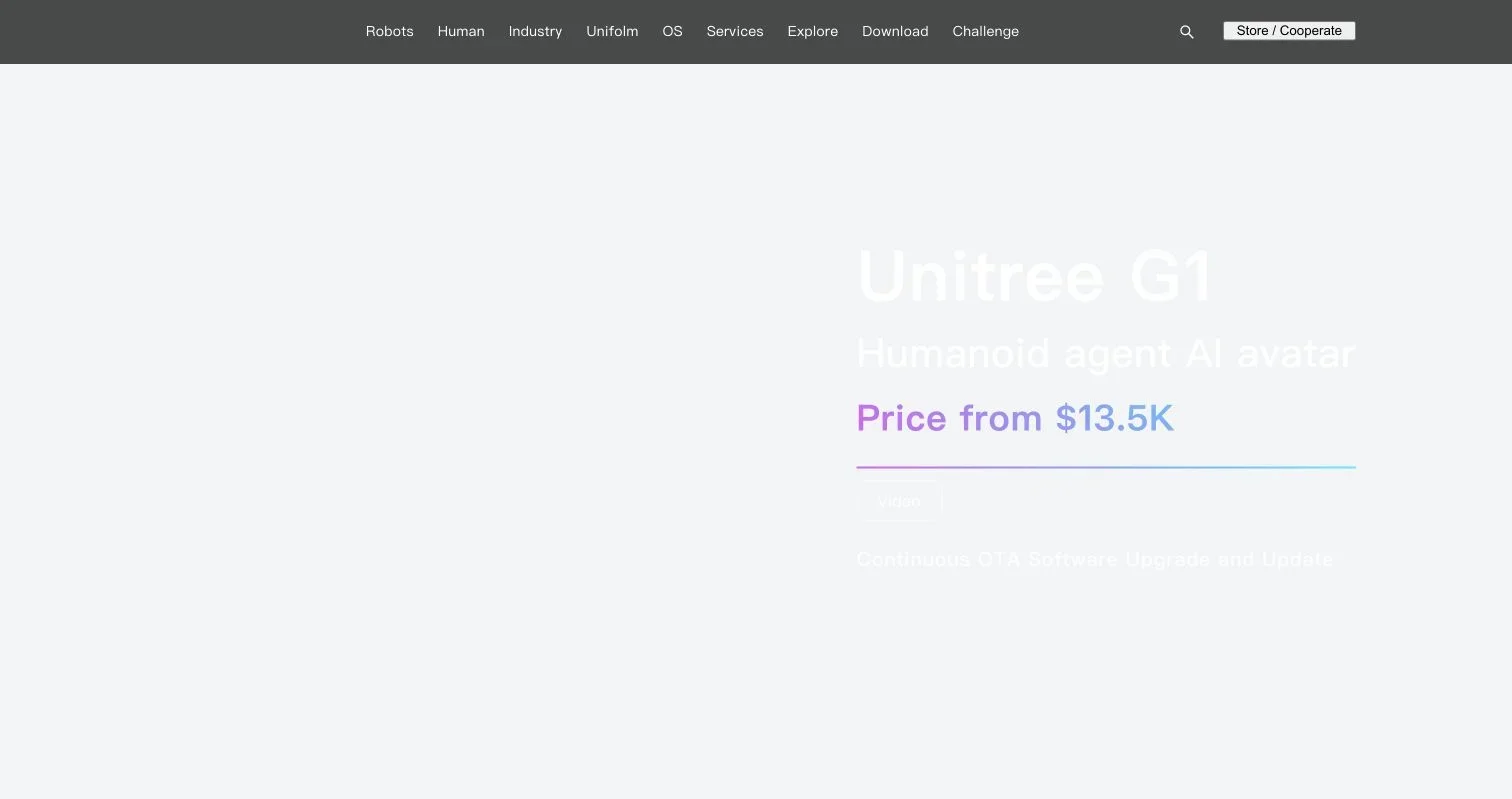
The Unitree G1 suits technical buyers who want a physical humanoid rather than a waiting-list spot. Unitree publishes a $13,500 base price, excluding tax and shipping, and lists the robot in its official store.
Source screenshot: Unitree G1 official product page, captured July 19, 2026. The displayed starting price excludes tax and shipping.
The G1 is about 1.32 meters tall and weighs 35 kilograms with its battery. The base configuration has 23 degrees of freedom, a depth camera, 3D LiDAR, microphones, a speaker, and an advertised runtime of about two hours. Unitree describes its locomotion work as driven by imitation and reinforcement learning and promotes its UnifoLM robot model.
The configuration boundary matters more:
- The $13,500 G1 is the entry model, not the fully equipped research configuration seen in every demonstration.
- Unitree lists secondary development for the G1 EDU, while the comparison table marks it unavailable on the base G1.
- Dexterous hands, additional waist and wrist joints, higher compute, and some manipulation hardware are optional.
- The base robot’s arms carry about 2 kilograms, depending heavily on arm position.
- Unitree says some demonstrated functions remain in development and may arrive later.
The G1 provides capable locomotion hardware, sensors, and a control platform, not a general-purpose employee that already knows how to stock shelves.
Unitree tells users to keep their distance and operate cautiously: a 35-kilogram machine with powerful joints is not a casual living-room gadget.
Buy it if: your team can build and validate its own policies, perception stack, teleoperation tools, and safety enclosure.
Skip it if: you need a supported production workflow with uptime guarantees and an integrator responsible for the outcome.
2. Unitree R1: one of the lowest-cost humanoid robots for sale
The Unitree R1 starts at $4,900, bringing humanoid hardware into the price range of a well-equipped workstation. It is a compact, roughly 29-kilogram platform with 20 to 26 degrees of freedom and about one hour of advertised battery life.
| What the R1 offers | Practical interpretation |
|---|---|
| Low public starting price | Accessible hardware, but options, freight, tax, and support can materially change the bill |
| Monocular or binocular camera, depending on version | Enough for experimentation; not a complete production perception system |
| Optional Orin-class compute on certain configurations | Buyers must confirm exactly which computer and SDK access are included |
| Dynamic movement | Useful for control research, education, and demonstrations |
| Roughly one-hour runtime | Extra batteries and a charging procedure will be needed for serious lab use |
The R1 lowers the cost of experimenting with learned locomotion policies but is less convincing as an autonomous worker. Unitree repeats that some sample functions are still being developed, and it warns individual purchasers to understand the limitations before ordering.
Choose the R1 for teaching, locomotion research, or early software experiments. For manipulation work, budget for end effectors, compute, fixtures, fall protection, and engineering time. The advertised price does not reflect the whole system’s cost.
3. Booster K1: best entry platform for education and robot soccer
Booster Robotics positions the K1 as an introductory embodied-AI platform and advertises a starting price of $5,999 on its official site. Purchases begin through a sales inquiry rather than a universal online checkout.
This compact robot is built for research, education, competitions, and repeated falls, a programmable laboratory platform, not a home assistant.
Reasons to consider it:
- A lower entry price than most research humanoids
- A developer system centered on robot soccer and reinforcement-learning locomotion
- Open-source tools and competition-oriented workflows
- Smaller size and mass than full-size industrial robots
- A clearer academic purpose than many vaguely described general-purpose machines
Regional support is the catch. Because Booster requests the buyer’s country and organization before quoting, availability is inquiry-based. International buyers should identify the actual distributor, repair location, parts inventory, warranty process, and import responsibility before paying.
Teams needing a larger platform can examine the Booster T1, which offers 23 to 41 degrees of freedom and Nvidia AGX Orin compute in some configurations. Booster publishes no global T1 price there, so request a configuration-level quote.
4. EngineAI PM01: a purchasable platform for dynamic-motion research
EngineAI’s official purchase page lists the PM01 at ¥188,000 and the simpler SA01 biped at ¥42,000. The PM01 is described as a lightweight, dynamic, open embodied-intelligence platform.
This humanoid is research hardware, not an autonomous business solution; buyers must supply much of the intelligence and application engineering.
| Buyer question | What to establish before ordering |
|---|---|
| Is the quoted price export-ready? | Currency, tax, freight, customs, and destination restrictions |
| What does fully open mean? | Low-level control access, SDK documentation, firmware rights, and interface stability |
| Are hands included? | Exact end effectors, payload, sensing, and replacement cost |
| How are falls handled? | Approved fall surfaces, joint inspection, spares, and repair turnaround |
| Can it run your AI stack? | Compute configuration, ROS support, model deployment path, and camera access |
The PM01 suits labs studying sim-to-real locomotion, whole-body control, and embodied AI. Its official CNY pricing does not prove that every international buyer can receive a supported unit, so obtain export and service terms in writing.
5. LimX Oli: best full-size developer platform sold by consultation
The LimX Oli is a 1.65-meter, 31-degree-of-freedom humanoid designed for research, industrial experimentation, property services, inspection, and events. LimX provides a buy button and sales process, but no public price.
Oli’s strongest features serve developers:
- Separate compute for motion control and perception
- Head- and chest-mounted depth cameras
- USB, Ethernet, and power interfaces for external sensors
- Quick-swap battery and modular construction
- Python development support
- Multiple end-effector options
Its bilingual voice system and preloaded dances help exhibitions but are not autonomous manipulation. LimX itself notes that configurations differ and that some listed capabilities are unavailable on certain versions.
Oli suits teams needing a full-size body with accessible interfaces. Start with a paid evaluation, not a fleet order based on video. Ask LimX to demonstrate your objects, floor surface, lighting, cycle time, and recovery procedure.
6. 1X NEO: the clearest AI humanoid robot reservation for homes
1X NEO is the only consumer robot here with transparent reservation terms. A $200 refundable deposit reserves either:
- Early Access ownership for $20,000, including a three-year warranty and priority delivery
- A future $499-per-month subscription with standard delivery
1X says US deliveries start in 2026, with other markets planned from 2027. Its preorder terms describe NEO as a personal, domestic-use product.
NEO uses 1X’s Redwood AI, a vision-language transformer paired with a diffusion policy. The model combines visual input, language embeddings, joint positions, and force information. It runs onboard and jointly controls locomotion and manipulation.
The reality is less cinematic:
- Early units arrive with basic autonomous capabilities that are expected to improve.
- For unfamiliar chores, owners can schedule Expert Mode, in which a 1X expert remotely supervises the robot.
- Buyers need clear answers about camera access, remote intervention, data retention, household consent, and what happens when connectivity fails.
- A preorder is not evidence that every advertised task will work reliably in every home.
Its soft body, tendon-driven actuation, low noise, and compliant construction improve safety but do not replace child, pet, stair, fire, privacy, and failure-mode testing.
NEO is the reservation to watch most closely, but it demands the highest tolerance for an unfinished experience.
7. Agility Digit: best commercially proven enterprise humanoid
Agility Digit is not a consumer purchase. Warehouses and factories engage Agility for assessment, validation, workflow integration, and Robots-as-a-Service deployment.
This controlled sales process is a strength. Digit has been deployed in regular operations at GXO, transferring totes from autonomous mobile robots to conveyors. Agility reports that the deployment has moved more than 100,000 totes, while commercial agreements also cover Toyota Motor Manufacturing Canada and other enterprise customers.
Digit’s deployment package includes Agility Arc, the cloud layer used to map workflows, orchestrate robots, monitor operations, and troubleshoot. Its AI combines learned physical capabilities with dependable navigation, workflow definitions, fleet controls, and site integration.
A credible Digit business case should measure:
- Current human cycle time, ergonomic exposure, and task variability
- Robot throughput across a full shift, including charging and recovery
- Exception frequency and the labor needed to resolve exceptions
- Integration with conveyors, AMRs, warehouse software, and safety systems
- Cost per successful tote movement, not cost per robot-hour in isolation
Digit best suits plants and distribution centers seeking an accountable deployment partner. Pricing is private and access selective, but it is commercial automation, not a developer kit.
8. UBTECH Walker S2: a commercial option for large industrial buyers
UBTECH says the Walker S series entered automotive production environments and that Walker S2 began mass production and delivery in November 2025. The company reports more than 1,000 full-size humanoid deliveries during 2025, mostly for industrial use.
Walker S2 is sold through enterprise contracts, not public retail pricing. Its unusual feature is autonomous battery swapping, aimed at longer factory operation without manual pack changes.
| Strength | Remaining diligence |
|---|---|
| Documented mass production and enterprise orders | Verify how many units perform production work rather than data collection or validation |
| Industrial focus | Request task-level throughput and intervention data |
| Battery-swapping concept | Inspect charger safety, swap reliability, and fleet scheduling |
| Manufacturer-led integration | Confirm service coverage outside China |
| Full-stack control, SLAM, and AI software | Establish which interfaces customers can access and modify |
Walker S2 suits automotive, electronics, logistics, and heavy-industry buyers able to run a structured pilot, not individuals.
Robots you still cannot simply buy
Some prominent machines remain closed platforms; production volume, factory demonstrations, and partnerships do not make them retail products.
| Robot | What is real in 2026 | What buyers cannot do yet |
|---|---|---|
| Figure 03 | Figure reports factory use at BMW and commercial work with Catalyst Brands; Helix 02 is its pixels-to-actions VLA | No public price, reservation, or general purchase program appears on the official site |
| Apptronik Apollo 2 | Fleets collect training data at Apptronik facilities and partner sites, with Gemini Robotics work underway | No public checkout, deposit, or standard delivery offer |
| Tesla Optimus | Tesla continues development and preparation for larger-scale production | Tesla publishes no consumer order page or delivery terms |
Do not pay unofficial sellers claiming access. Contact the manufacturer through its official domain and verify the contracting entity.
What AI actually means in AI humanoid robots
AI-powered means little without a description of the control loop. Robots combine several approaches.
| Approach | What it does | Where it fits |
|---|---|---|
| Reinforcement-learning policy | Learns locomotion or whole-body behavior through rewards, often in simulation before transfer to hardware | Unitree, Booster, and dynamic-motion research |
| Vision-language-action model | Converts camera observations and language instructions into robot actions | 1X Redwood and Figure Helix |
| Imitation or behavior cloning | Learns from human demonstrations or teleoperated robot episodes | Household and manipulation training |
| Classical navigation and control | Uses mapping, localization, trajectory planning, state estimation, and feedback control | Production navigation and dependable low-level motion |
| Teleoperation | Lets a human guide the machine directly or resolve unfamiliar tasks | Data collection, exception handling, and NEO Expert Mode |
| Fleet orchestration | Assigns work, monitors status, coordinates charging, and connects robots to facility systems | Digit and industrial deployments |
A VLA can generalize beyond rigid sequences but may fail unpredictably. Classical control often carries the operational workload, so production systems will remain hybrids.
Buyer checklist before you buy a humanoid robot
Treat buying a humanoid as a robotics integration project. Even a $4,900 platform becomes expensive after compute, hands, batteries, freight, engineering, and repairs.
| Item | What to check | Why it matters |
|---|---|---|
| Commercial status | Shipping product, preorder, paid pilot, or prototype | Prevents an announcement from being mistaken for inventory |
| Exact configuration | Compute, hands, sensors, batteries, charger, controller, and SDK | Starting prices usually describe the least capable version |
| Autonomy boundary | Which tasks run autonomously and when humans intervene | Teleoperation can hide weak autonomy and add labor cost |
| Geography | Supported countries, customs, certifications, and repair locations | A robot that ships is not necessarily supported locally |
| Safety case | Risk assessment, emergency stops, speed limits, guarding, and tested failure modes | Humanoid shape does not make powerful machinery safe |
| Integration | APIs, ROS support, network requirements, fleet software, and facility interfaces | Production value comes from the whole workflow |
| Service terms | Warranty exclusions, spare-part lead time, remote support, and repair turnaround | Falls and actuator failures can stop a program for weeks |
| Data governance | Video access, storage, model training, remote operators, and deletion controls | Home and workplace cameras record sensitive information |
| Acceptance test | Your objects, lighting, floor, task rate, and full-shift duration | A scripted manufacturer demo proves very little about your site |
| Exit terms | Refunds, pilot termination, hardware ownership, and data export | Early-stage suppliers and products can change direction quickly |
How to compare humanoid robot prices without buying the hype
Use this process:
-
Write one narrow job. Define the start state, object set, distance, expected cycle time, allowable failures, and human escalation path.
-
Choose the correct product class. Buy Unitree, Booster, EngineAI, or LimX when you need programmable hardware. Reserve NEO only if you accept an early consumer product. Approach Agility or UBTECH when you need a supported industrial deployment.
-
Demand a continuous demonstration. Ask for an uncut run using your objects and environment. Ten successful cycles tell you more than ten edited videos.
-
Run a paid pilot with acceptance criteria. Measure throughput, interventions, damage, charging time, network outages, and maintenance labor.
-
Scale only after the economics survive exceptions. A humanoid that completes 90 percent of cycles may still be unusable if a technician must rescue every tenth attempt.
Final recommendation
For most engineers buying a humanoid robot in 2026, the Unitree G1 EDU is the most balanced starting point, combining accessible hardware, a known price family, sensing, optional manipulation, and secondary development support. Confirm the exact EDU quote before budgeting.
For lower-cost education or locomotion, compare Unitree R1 and Booster K1. For full-size research, request matched quotes from LimX and EngineAI instead of comparing headline prices.
For homes, 1X NEO offers a genuine reservation with stated US timing but remains early access to a developing service. For warehouses and factories, Digit has the strongest evidence, already performing repetitive material handling under commercial agreements.
The best robot has an autonomy boundary, safety plan, service model, and cost that still make sense after the demo.
Frequently Asked Questions
Which humanoid robot is the best choice for a research lab?
Unitree G1 EDU is the strongest general-purpose option for teams that need accessible hardware, sensors, and secondary development support. Lower-budget labs should compare Unitree R1 and Booster K1, while teams needing a full-size platform can request quotes for LimX Oli and EngineAI PM01.
How much should I budget beyond the advertised robot price?
Plan for shipping, taxes, import duties, batteries, compute, hands or other end effectors, safety equipment, spare parts, and engineering time. These additions can materially exceed the starting price, especially when building a reliable manipulation or production system.
Can today’s AI humanoid robots work autonomously without supervision?
Most still operate within narrow tasks and require setup, monitoring, or human intervention when conditions change. Ask vendors to distinguish autonomous operation from teleoperation, scripted demonstrations, and remotely supervised exception handling.
Can I buy a humanoid robot for home use in 2026?
1X NEO offers the clearest consumer reservation, with US deliveries stated to begin in 2026. However, early units will have limited autonomy, and buyers should examine privacy, remote-support, connectivity, household-safety, and refund terms before committing.
What should international buyers confirm before ordering?
Verify that the exact configuration can legally ship to your country and determine who handles customs, certification, warranty work, and repairs. Also confirm where replacement parts are stocked, how long service takes, and whether local technical support is available.
How can a business test whether a humanoid robot is economically worthwhile?
Start with one narrowly defined job and run a paid pilot using the actual objects, floor, lighting, systems, and shift duration. Measure successful throughput, intervention frequency, charging, downtime, damage, and maintenance labor rather than relying on demonstration videos or hourly robot cost alone.
What safety and privacy checks are needed before deployment?
Require a documented risk assessment covering emergency stops, speed and force limits, falls, stairs, people, pets, fire, and network failures. For camera-equipped or remotely assisted robots, establish who can access recordings, how data is stored or used for training, and how it can be deleted.